3-152 ENGINE AND ENGINE OVERHAUL


INSPECTION AND COMPONENT REPLACEMENT

Front, Intermediate and Rear Housings . See Fig. 351, 352, 353, 354 and 355


1. Check the housing for signs of gas or water leakage.
2. Remove the sealing compound from the housing surface with a cloth or brush soaked in solvent or thinner.
3. Remove the carbon deposits from the front housing with extra fine emery cloth. When using a carbon scraper, take extra care not to damage the surface of the housing.
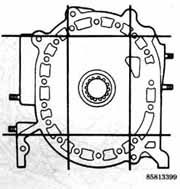
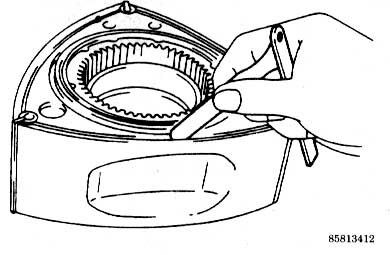
4. Check for distortion by placing a straightedge on the surface of the housing. Measure the clearance between the straightedge and the housing with a feeler gauge. If the clearance is greater than 0.0016 in. (0.04mm) at any point, replace the housing.
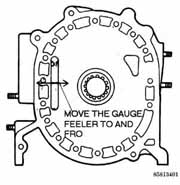
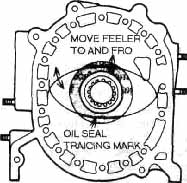
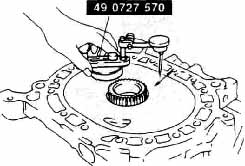
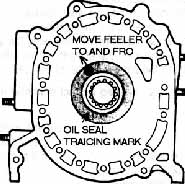
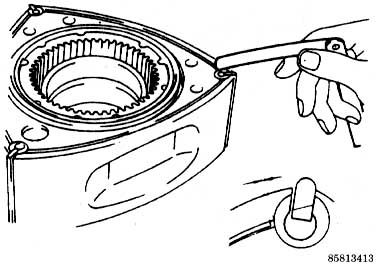
5. Use a dial indicator with a sled attachment (gauge body) to check for wear on the rotor contact surfaces of the housing. Mazda offers such an attachment under part number 49-0727-570 or equivalent. To check for stepped wear on the rotor housing sliding surfaces, mount the dial indicator on the sliding surface of the housing. To measure stepped wear caused by the side seal at the sides of the housing, move the dial indicator gauge feeler to and fro as shown in the illustration. The wear limit is 0.0039 in. (0.10mm). Check the side seal stepped wear across the middle of the housing with the dial indicator, moving it as shown in the illustration. The wear limit inside the oil seal tracing marks is 0.0004 in. (0.01mm), and the wear limit outside the oil seal tracing marks is 0.0039 in. (0.10mm). Check for stepped wear by the oil seal with the dial gauge. The wear limit is 0.0008 in. (0.02mm).
6. If the front, intermediate and/or rear side housings are beyond the above wear limits, they can be ground if the required finish can be maintained. If the wear is greater than the values provided above, replace the housing.

The wear at either end of the minor axis is greater than at any other point on the housing. However, this is normal and should not be cause for concern.


fig351.jpg (14633 bytes)

fig352.jpg (15367 bytes)

Fig. 351. Check the rotor housings for warpage along these lines Fig. 352. Checking for housing wear with a dial indicator and gauge body
fig353.jpg (14756 bytes) fig354.jpg (19416 bytes) 
Fig. 353. Measuring stepped wear at the sides of the housing Fig. 354. Measuring stepped wear across the middle of the housing


ENGINE AND ENGINE OVERHAUL 3-153


Front Stationary Gear and Main Bearing

1. Examine the teeth of the stationary gear for wear or damage.

2. Be sure that the main bearing shows no signs of excessive wear, scoring, or flaking.
3. Check the main bearing-to-eccentric journal clearance by measuring the journal with a vernier caliper and the bearing with a pair of inside calipers. The standard clearance is 0.0016-0.0031 in. (0.04-0.08mm). If the clearance exceeds the limit, replace the front main bearing as described later in this section.


Front Main Bearing Replacement

1. Unfasten the securing bolts, if used. Remove the stationary gear and main bearing assembly from the housing, using puller tool 49-0813-235 or equivalent.

2. Press the main bearing out of the stationary gear.
3. Press a new main bearing into the stationary gear, so that it is in the same position as the old one.
4. Align the slot in the stationary gear flange with the dowel pin in the housing, then press the gear into place. On later engines, align the bearing lug with the slot in the gear. Install the securing bolts, if applicable.


Rear Stationary Gear and Main Bearing

Inspect the rear stationary gear and main bearing in a similar manner to the front. In addition, examine the 0-ring, which is located in the stationary gear, for signs of wear or damage. Replace the 0-ring, if necessary. If the stationary gear must be replaced, follow the rear main bearing replacement procedure.


Rear Main Bearing Replacement

1. Remove the rear stationary gear securing bolts.

2. Drive the stationary gear out of the rear housing with a brass drift.
3. Apply a light coating of grease to a new 0-ring and fit it into the groove on the stationary gear.
4. Apply sealer to the flange of the stationary gear.
5. Install the stationary gear on the housing so that the slot on its flange aligns with the pin on the rear housing. On later engines, align the bearing lug with the housing slot. Use care not to damage the 0-ring during installation.
6. Tighten the stationary gear bolts evenly, in several stages, to 12-17 ft. Ibs. (16-23 Nm).


Rotor Housings I See Figure 356

1. Examine the inner margin of both housings for signs of gas or water leakage.

2. Wipe the inner surface of each housing with a clean cloth to remove the carbon deposits.
3. Clean all of the rust deposits out of, the cooling passages of each rotor housing.
4. Remove the old sealer using the proper removal solvent.
5. Examine the chromium-plated inner surfaces for scoring, flaking, or other signs of damage. If any are present, the housing must be replaced.
6. Check the rotor housings for distortion by placing a straightedge on the axes.
7. If distortion exceeds 0.002 in. (0.05mm), replace the rotor housing.
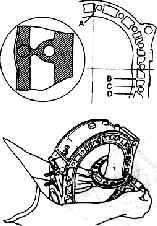
8. Check the widths of both rotor housings, at points A, B, C, and D near the trochoid surfaces of each housing, using a vernier caliper, as illustrated. Compare the difference between the value obtained at point A and the minimum value of points B, C and D. If the difference between the values obtained is greater than 0.0024 in. (0.06mm), replace the housing. A rotor housing in this condition will be prone to gas and coolant leakage.


fig355.jpg (20376 bytes)

fig356.jpg (17120 bytes)

Fig. 355. Measuring stepped wear caused by the oil seal Fig. 356. Checking rotor housing width


3-154 ENGINE AND ENGINE OVERHAUL

Rotors
See Figure 357
1. Check the rotor for signs of blow-by around the side and corner seal areas.
2. The color of the carbon deposits on the rotor should be brown, just as in a piston engine. Usually, the carbon deposits on the leading side of the rotor are brown, while those on the trailing side tend toward black (as viewed from the direction of rotation).
3. Remove the carbon on the rotor with a scraper or extra fine emery paper. Use the scraper carefully when cleaning the seal grooves to avoid any damage.
4. Wash the rotor in solvent and blow it dry with compressed air.
5. Examine the internal gear for cracks or damaged teeth. If the internal gear is damaged, the rotor and gear must be replaced as a single assembly.
6. With the oil seal removed, check the land protrusions by placing a straightedge over the lands. Measure the gap between the rotor surface and the straightedge with a feeler gauge.

7. Check the clearance between the housings and the rotor on both of its sides:

a. Measure the rotor width with a vernier caliper at the points indicated in the corresponding illustration.
b. Compare the rotor width against the width of the previously measured rotor housing.
c. Replace the rotor, if the difference between the two measurements is not 0.0047-0.0074 in. (0.12-0.19mm) for the 1979-85 carbureted engine or 0.0047-0.0083 in. (0.12-0.21 mm) for the 1984-90 fuel injected engine.
8. If the clearance exceeds the specified values, replace the rotor. If the clearance is less than specification, it means that the internal gear must be removed. To dislodge the gear from the rotor bore, smack it lightly with a plastic-faced hammer, being careful not to damage the rotor. With the gear removed, recheck the side housing-to-rotor clearance again.
9. The corner seal bores can be checked with a gauge (tool number 49 0839 15 or equivalent), available from Mazda. If neither end of the gauge can be fit into the bores, it is safe to reuse the original corner seals. If the "go" side of the gauge does fit into the bore, but the larger "no go" side does not, use new seals. If both sides of the gauge fit into the bores, the rotor must be replaced.
10. Check the rotor bearing for wear, flaking, scoring or damage. Replace the bearing if these conditions are found.Check the bearing oil clearance by measuring the appropriate bearing journal diameter on the eccentric shaft with a micrometer. Next, measure the inner diameter of the rotor bearing.
The standard rotor bearing journal diameter is 2.913 in. (74mm).
11. Find the oil clearance by subtracting the rotor bearing diameter from the rotor journal diameter. The standard clearance is 0.0016-0.0031 in. (0.04-0.08mm). If the clearance is greater than 0.0039 in. (0.10mm), replace the rotor bearing as described later in this section.
Rotor Bearing Replacement
1. Check the clearance between the rotor bearing and the rotor journal on the eccentric shaft. Measure the inner diameter of the rotor bearing and the outer diameter of the journal. The | wear limit is 0.0039 in. (0.1mm); replace the bearing if it exceeds specification.
2. Place the rotor on the support so that the internal gear is facing downward. Using puller tool 49-0813-240 (or equivalent) without its adaptor ring, press the bearing out of the rotor. Being careful not to damage the internal gear.
3. Place the rotor on the support with the internal gear facing upward. Place the new rotor bearing on the rotor so that the bearing lug is in line with the slot of the rotor bore.
4. Remove the screws which attach the adaptor ring to the special tool. Using the special tool and adaptor ring, press fit the new bearing until the bearing is flush with the rotor boss. |

Oil Seal Inspection

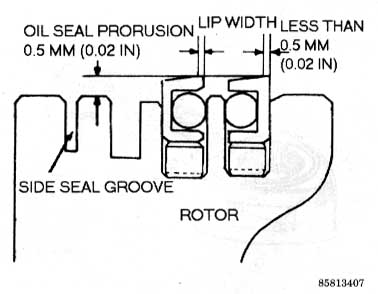
See Figures 358 and 359

1. Examine the oil seal while it is mounted in the rotor.
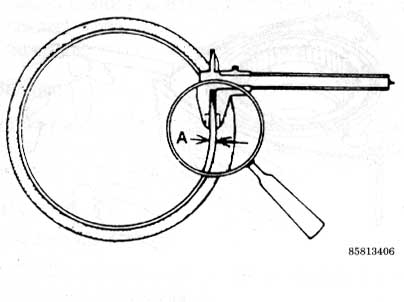
2. If the width of the oil seal lip is greater than 0.020 in. (0.5mm), replace the oil seal. ,
3. If the protrusion of the oil seal is greater than 0.020 in. (0.5mm), replace the seal.
Oil Seal Replacement
1. Pry the seal out by inserting a small prybar into the slots on the rotor. Be careful not to deform the lip of the oil seal if it is to be reinstalled.
2. Fit both the oil seal springs into their respective grooves, so that their ends are facing upward and their gaps are opposite each other on the rotor.
3. Insert a new 0-ring into each of the oil seals. Before installing the 0-rings into the oil seals, fit each of the seals into its proper groove on the rotor. Check to see that all of the j seals move smoothly and freely.
4. Coat the oil seal groove and the oil seal with clean engine oil.
5. Gently press the oil seal into the groove with your fingers. Be careful not to distort the seal. Be sure that the white mark is on the bottom side of each seal when it is installed.
6. Repeat the installation procedure for the oil seals on both sides of each rotor.


fig357.jpg (31500 bytes)
Fig. 357 Checking rotor width


ENGINE AND ENGINE OVERHAUL 3-155

Apex Seals
See Figures 360, 361,362 and 363
1. Remove the carbon deposits from the apex seals and heir springs. Do not use emery cloth on the seals, as it will damage their finish.
2. Wash the seals and the springs in cleaning solution.
3. Check the apex seals for cracks.
4. Test the seal springs for weakness.
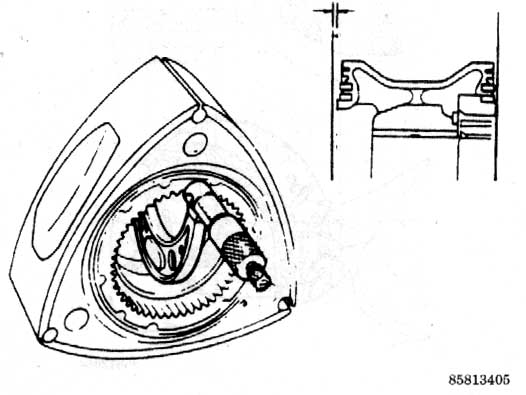
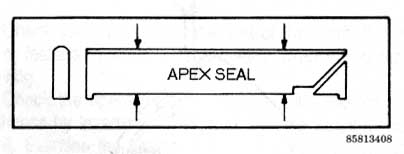
5. Use a micrometer to check the seal height.
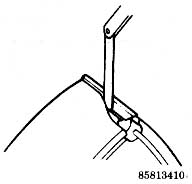
6. With a feeler gauge, check the side clearance between the apex seal and the groove in the rotor. Insert the gauge until its tip contacts the bottom of the groove. If the gap is greater than 0.0035 in. (0.09mm) for the 1983-85 12A engine, 3r 0.0059 in. (0.15mm) for the 1984-90 13B engine, replace the seal. The standard range for non-turbo engines is 0.0024-0.0040 in. (0.06-0.10 mm) and 0.0020-0.0040 in. (0.05-0.10mm) for turbo engines.
7. Check the gap between the apex seals and the side housing by using a vernier caliper to measure the length of each apex seal. Compare this measurement to the minimum figure obtained for the rotor housing width.
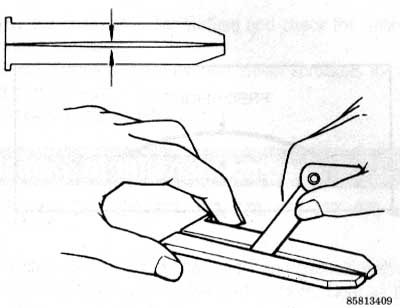
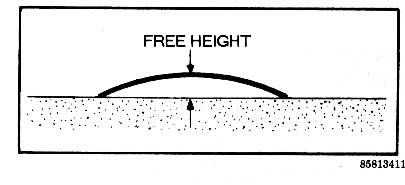
8. Check the apex seal spring for wear and measure its free height. If less than 0.2165 in. (5.5mm), replace the spring.
9. If the seal is too long, sand the ends of the seal with emery cloth until the proper length is reached. Do not use the emery cloth on the faces of the seal.
Side Seals
See Figures 364 and 365
1. Check the side seal free movement in the rotor groove. You should be able to press down along its length with your finger.
2. Measure the side seal protrusion from the rotor surface. If the protrusion is less than 0.02 in (0.5mm), replace the side seal spring.
3. Measure the clearance between the side seal and its groove in the rotor with a feeler gauge. (The standard clearance is given in the specification chart, earlier in this section.)


fig358.jpg (16182 bytes) fig359.jpg (19631 bytes)


Fig. 358 Checking rotor oil seal width Fig. 359 Oil seal width and protrusion
fig360.jpg (9089 bytes) fig361.jpg (17460 bytes)
Fig. 360 Apex seal height Fig. 361 Apex seal warpage


ENGINE AND ENGINE OVERHAUL 3-156


If the clearance is greater than 0.0039 in. (0.10mm), replace the side seal.
4, Using a feeler gauge, check the clearance between the side seal and the corner seal when the seals are installed on the rotor. If the clearance is greater than 0.0157 in. (0.4mm), replace the side seal. When installing a new side seal, correct the clearance between the side and corner seals by grinding the end of the side seal and the rounded corner seal with a fine file. The clearance should be 0.0020-0.0059 in. (0.05-0.15mm). If it exceeds this, the performance of the seals will deteriorate.
There are 4 different types of side seals, depending upon location. Do not mix up the seals and be sure to use the proper type of seal for replacement.


fig362.jpg (7888 bytes)

Fig. 362 Apex seal-to-rotor clearance

fig363.jpg (13299 bytes)

Fig. 363 Apex seal spring free height

fig364.jpg (21980 bytes)

Fig. 364 Checking side seal-to-rotor groove clearance

fig365.jpg (25504 bytes)

Fig. 365 Checking side seal-to-corner seal clearance

fig366.jpg (12917 bytes)

Fig. 366 Corner seal protrusion


Corner Seals  ( See Figure 366)

1. Inspect the corner seal and spring for wear, cracks, or damage and replace, if necessary.


ENGINE AND ENGINE OVERHAUL 3-157


2. Make sure the comer seal has free movement by pressing on it with your finger.
3. Measure the corner seal protrusion from the rotor surface. It should protrude at least 0.02 in (0.5mm). If not, replace the corner seal spring.
4. Inspect the corner seal spring for wear.
 

Seal Springs

Check the seal springs for damage or weakness. Be especially careful when checking the spring areas which contact either the rotor or the seal.
 

Eccentric Shaft
See Figures 367 and 368

1. Wash the eccentric shaft in solvent and blow the oil passages dry with compressed air.
2. Check the shaft for wear, cracks, or other signs of damage. Make sure that none of the oil passages are clogged.
3. Measure the shaft journals. Replace the shaft if any of its journals show excessive wear.
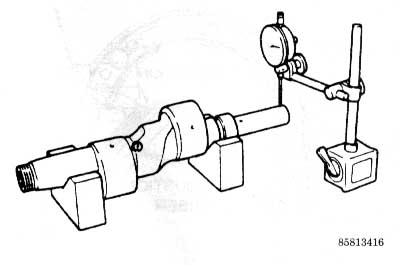
4. Check eccentric shaft run-out. Rotate the shaft slowly and note the dial indicator reading. Run-out should not exceed 0.0047 in. (0.12mm) as measured from the end of the shaft. If run-out is greater than specification, replace the eccentric shaft.
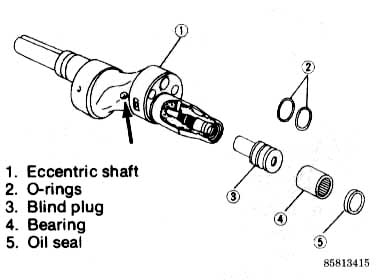
5. Check the blind plug at the end of the shaft. If it is loose or leaking, remove it with an Alien wrench and replace the 0-ring.
6. Check the operation of the needle roller bearing for smoothness by inserting a mainshaft into the bearing and rotating it. Examine the bearing for signs of wear or damage. Check the oil jet for spring weakness, sticking or ball damage.
7. Replace the bearings, if necessary, with special bearing replacer tools 49-0823-073 and 49-0823-072, or equivalent.
 

Needle Bearing and Thrust Plate

1. Inspect the needle bearing for wear and damage.
2. Inspect the bearing housing and the thrust plate for wear and damage.
 

Oil Pump Drive Chain and Sprocket

1. Lay the chain on a flat surface and check the entire length for broken links.

2. Check the oil pump drive and driven sprockets for missing and broken teeth.
3. Replace parts as necessary.
fig367.jpg (15797 bytes)
Fig. 367 Exploded view of eccentric shaft. Remove the oil jet plug (indicated by the arrow) to check the spring and steel ball
fig368.jpg (14222 bytes)
Fig. 368 Checking eccentric shaft run-out


Assembly of Internal Components

> See Figures 369, 370, 371, 372, 373, 374, 375, 376 and 377


1. Replace all 0-rings, rubber seals and gaskets with new parts. Place the rotor on a rubber pad or cloth. Coat all the engine sliding surfaces with clean engine oil.

2. Install the oil seal rings in their respective grooves in the rotors with the edge of the spring in the stopper hole. The oil seal springs are painted cream or blue in color. The cream colored springs must be installed on the front faces of both rotors. The blue colored springs must be installed on the rear faces of both rotors. When installing each oil seal spring, the painted, square side of the spring must face upward toward the oil seal.
3. Coat the new 0-ring with clean engine oil and install in each seal groove. Place each oil seal in the groove so that the square edge of the spring fits in the stopper hole of the oil seal. Push on the head of the oil seal slowly with your fingers, being careful that the seal is not deformed. Be sure that the oil seal moves smoothly in the groove before installing the 0- ring. An old seal can be used as an installation tool.
4. Lubricate each oil seal and groove with engine oil. Check the movement of the seal. It should move freely when the head of the seal is pressed.
5. Check the oil seal protrusion and install the seals on the other side of each rotor. Oil seal protrusion must not exceed 0.016 in. (0.4mm).
6. Install the apex seals (without springs and side pieces) into their respective grooves, so that each side piece will be positioned to the rear side of the rotor.

ENGINE AND ENGINE OVERHAUL 3-157


 7. Install the corner seal springs and corner seals into their respective grooves.
8. Install the side seal springs and side seals into their respective grooves.
9. Confirm the smooth movement of each seal by pressing its head.
10. Mount the front housing on a workstand so that the top of the housing is up. Install the thrust plate so that the
chamfered edge faces the front of the housing. Torque the thrust plate bolts to 12-17 ft. Ibs. (16-23 Nm).
11. Lubricate the internal gear of the rotor with engine oil.
12. Hold the apex seals with a rubber band around the rotor's perimeter to keep the seals attached. Place the rotor on
the front housing, being careful not to drop the seals. Turn the front housing so that the sliding surface faces upward.
13. Mesh the internal and stationary gears so that one of the rotor apexes is at any one of the four places shown, then
remove the rubber band which is holding the apex seals in position.


ENGINE AND ENGINE OVERHAUL 3-158

 14. Lubricate the front rotor journal of the eccentric shaft
and the eccentric shaft main journal with engine oil.
15. Insert the eccentric shaft. Be careful that you do not
damage the rotor bearing and main bearing.
16. Apply sealing agent to the front side of the front rotor
housing.
17. Apply a light coat of petroleum jelly (not grease) onto new 0-rings and rubber seals, then install the 0-rings and seals on the front side of the rotor housing. If the engine is being overhauled, install the seal protector behind the inner sealing rubber to improve durability.
!!!!The inner rubber seal is of the square type. The wider white line of the rubber seal should face the combustion chamber and the seam of the rubber seal should be positioned as illustrated. Do not stretch the rubber seal.!!!
18. Invert the front rotor housing, being careful not to let the rubber seals and 0-rings fall-from their grooves, and mount it on the front housing.19. Lubricate the tubular dowels with engine oil, then insert them through the front rotor housing holes and into the front housing.
20. Insert each apex seal spring so that both ends of the spring may support the back side of the seal.
21. Install the corner seal springs and corner seals into their respective grooves.
22. Install the side seal springs and side seals into their respective grooves.
23. Fit an assist piece between the spring and seal, then install each side piece in its original position. Be sure that the spring seats properly on the side piece, as shown.
24. Confirm the smooth movement of each seal by pressing its head.
25. Apply sealer to the rear side of the front rotor housing.
26. Install new 0-rings, rubber seals and seal protector on the rear side of the front rotor housing, in the same manner as on the front side.

ENGINE AND ENGINE OVERHAUL 3-160

27. Lubricate the side pieces with engine oil. Make sure that the front rotor housing is free of foreign matter and lubricate the sliding surface of the front housing with engine oil.
28. Turn the front housing assembly with the rotor, so that the top of the housing is up. Pull the eccentric shaft about 1 in. (25mm).
29. Position the eccentric portion of the eccentric shaft diagonally, to the upper right.
30. Install the intermediate housing over the eccentric shaft and onto the front rotor housing. Turn the engine so that the rear of the engine is up.
31. Install the rear rotor and rear rotor housing, following the same steps as for the front rotor and front rotor housing.
32. Lubricate the stationary gear and main bearing.
33. Install the rear housing onto the rear rotor housing.
Make sure the side pieces of the front and rear apex seals are not pinched between the rotor and side housings.
34. If necessary, turn the rear rotor slightly to mesh the rear housing stationary gear with the rear rotor internal gear.
35. Install a new washer on each tension bolt, and lubricate each bolt with engine oil.
36. Install the tension bolts, then tighten them to specification using several stages of the proper sequence. Be sure the bolts are installed in their original positions with new seal washers. Longer bolts are used in later engines and are not interchangeable.
f*0n 1984-85 carbureted engines, bolt number 11 does not apply. For those engines, delete bolt number 11 from the tension bolt torque sequence.
37. After tightening the bolts, turn the eccentric shaft to be sure that the shaft and rotors turn smoothly and easily.
38. Lubricate the oil seal in the rear housing.
39. On vehicles equipped with a manual transmission, install the flywheel on the rear of the eccentric shaft so that the keyway of the flywheel fits the key on the shaft.
a. Apply sealer to both sides of the flywheel lockwasher and install the lockwasher.
b. Install the flywheel locknut. Hold the flywheel securely and tighten the nut to 350 ft. Ibs. (475 Mm).
40. On vehicles with an automatic transmission, install the key, counterweight, lockwasher and nut. Tighten the nut to 350 ft. Ibs. (475 Nm). Install the driveplate on the counterweight and tighten the attaching nuts.
41. Turn the engine so that the front faces up.
42. Install the thrust plate with the tapered face down, and install the needle bearing on the eccentric shaft. Lubricate with engine oil.
43. Install the bearing housing on the front housing. Tighten the bolts and bend up the lockwasher tabs. The spacer should be installed so that the center of the needle bearing comes to the center of the eccentric shaft, and the spacer should be seated on the thrust plate.
44. Install the needle bearing on the shaft and lubricate it with engine oil.
45. Install the balancer and thrust washer on the eccentric shaft.
46. Install the oil pump drive chain over both of the sprockets. Install the sprocket and chain assembly over the eccentric shaft and oil pump shaft simultaneously. Install the key on the eccentric shaft. Be sure that both of the sprockets are engaged with the chain before installing them over the shafts.47. Install the distributor drive gear onto the eccentric shaft with the F mark on the gear facing the front of the engine. Slide the spacer and oil slinger onto the eccentric shaft.
48. Align the keyway and install the eccentric shaft pulley. Tighten the pulley bolt to 72-87 ft. Ibs. (98-118 Nm) on 1979-85 engines and 80-98 ft. Ibs. (108-133 Nm) on 1986-89 engines.
49. Turn the engine until the top of the engine faces up. 50. Check the eccentric shaft end-play in the following manner:
a. Attach a dial indicator to the flywheel. Move the flywheel forward and backward.
b. Note the reading on the dial indicator, it should be 0.0016-0.0028 in. (0.04-0.07mm).
c. If the end-play is not within specification, adjust it by replacing the front spacer. Spacers come in four sizes, ranging from 0.3150-0.3181 in. (8.00-8.08mm). If necessary, a spacer can be ground on a surface plate with emery paper.
d. Check the end-play again and, if it is now within specification, proceed with the next Step.
51. Remove the pulley from the front of the eccentric shaft. Tighten the oil pump drive sprocket nut and bend the locktabs on the lockwasher.
52. Fit a new 0-ring over the front cover oil passage.
53. Install the chain tensioner, if equipped, and tighten its securing bolts.
54. Position the front cover gasket and the front cover on the front housing, then secure the front cover with its attachment bolts.
55. Install the eccentric shaft pulley again. Tighten its bolt to the required torque value. 
56. Turn the engine so that the bottom faces up.
57. Cut off the excess gasket on the front cover along the mounting surface of the oil pan.
58. Install the oil strainer gasket and strainer on the front housing, then tighten the attaching bolts.
59. Apply sealer to the joint surfaces of each housing.
60. Install the oil pan.
61. Turn the engine so that the top is up, then complete assembly of the external components,


Assembly of External Components
CARBURETED ENGINES


1. Install the water pump.
2. Attach two 0-rings to the oil filter body, then install the oil filter.
3. Rotate the eccentric shaft until the yellow mark (leading side mark) aligns with the pointer on the front cover.
4. Align the marks on the drive gear and housing, then install the distributor so that the lockbolt is in the center of the slot.
5. Rotate the distributor until the leading points start to separate (1979 only) or the air gap is correct (1980-1985), then tighten the distributor locknut. (For more details, please refer to Section 2.)
6. Install the gaskets and thermal reactor/exhaust manifold.
7. Install the hot air duct.